
Replenishment planning for a large retailer means constant change: new seasons, new vendors, new regions. Every update used to mean a ticket and a wait. Here is what happened when they added Megaladata....
Megaladata as an Automation Tool: Case Study

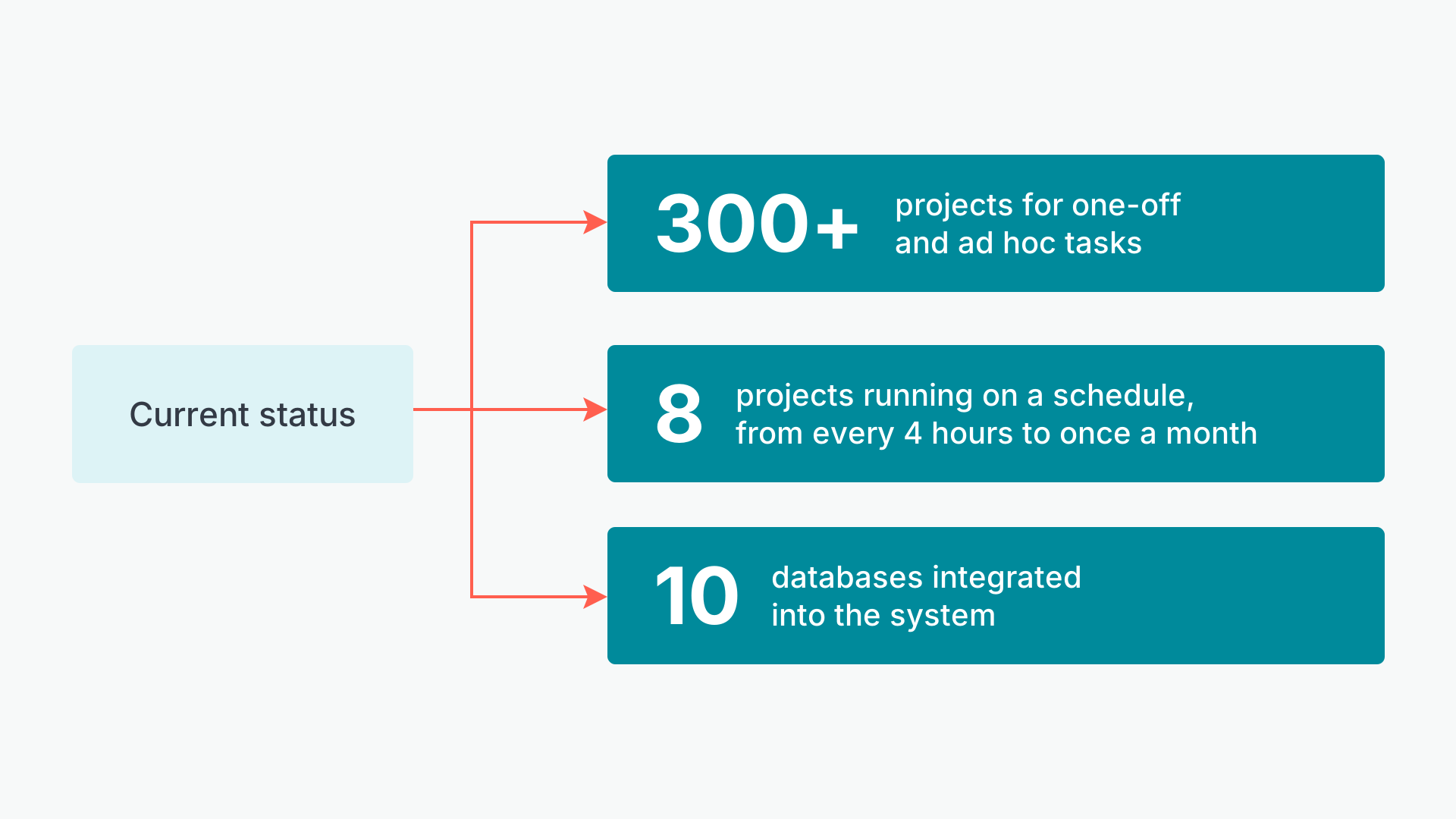
A large telecom operator unified dozens of disparate data sources into a single system on Megaladata. Information processing time dropped from several days to hours: a 3-5 times speedup. More than 300 projects for ad hoc and situational tasks let departments respond to new challenges instantly.
Situation before the project started
The company is a large telecommunications operator providing mobile communications, cloud solutions, and retail services. For years, the team relied on Excel for most data tasks.
Over time, this led to more and more limitations:
- Disparate projects and a complex data exchange structure hindered collaboration and slowed information sharing.
- This made working with reports more difficult.
- Inconvenience when working with growing data volumes caused performance to drop.
As a result, labor costs and analytics preparation time increased, and business process manageability declined.
Solution
The company launched a pilot project with Megaladata, starting with retail.
The migration of existing analytical projects to Megaladata went through several stages:
- Manual transfer and structural reorganization
- Preparation and population of a centralized database.
- Automation of individual analytical tasks and scheduling them for routine execution.
Over time, it became clear that Megaladata handles a much broader range of tasks than the initial scope. The list of data sources expanded: the platform now connects to databases from isolated projects, such as antifraud, revenue assurance, and enterprise data warehouse sources.
The scope of Megaladata use also grew significantly:
- Preparing diverse subscriber statistics with a high level of detail.
- Calculating service margin.
- Backing up antifraud system statistics with a short retention horizon.
- Analyzing individual key events.
Megaladata use in the company grew from local tasks in the automated credit decisioning area (1-2 users, 1 data source) to a full-fledged data management system with 10 users and more than 5 data sources.
Results
Implementing Megaladata moved the team from manual, fragmented operations to a centralized, automated, and scalable data system.
Individual projects
Implementing the platform at the company led to unique analytical solutions.
Data mart:
- Accumulates the results of many disparate projects.
- Serves as the central point for instant process assessment.
- Provides visualization options (Cubes).
- Simplifies data access and reduces the load on users, who no longer need to switch between dozens of separate files.
Daily analytics:
- Combines a large number of regular calculations into a single data processing chain.
- Eliminates the need to start many separate tasks manually.
- Ensures stable operation of processes with different frequencies: from several times a month to several times an hour.
Telecom component profitability assessment:
- One of the most complex and resource-intensive workflows implemented in Megaladata.
- Includes 200+ workflow nodes and works with table partitions in the database.
- Consumes more than 13 GB of RAM at peak load.
- Two preparatory projects run before the main calculation, which improves the quality and accuracy of the final analysis.
Key effects of implementing Megaladata:
- Speed: Data processing time dropped from several days to hours, that is, by at least 3-5 times.
- Transparency: A clear project structure and convenient analytics support.
- Resource savings: Lower labor costs and fewer errors.
- Unified storage: Creating a data mart freed employees from working with many separate files.
- Flexibility: The ability to solve both routine and complex analytical tasks.
- Scalability: From individual tasks to a full-fledged system that covers several business areas.
- Adaptability: The new system supports continuous development as business requirements change and improves service margins.
If your team is facing the same bottlenecks, contact us to see how Megaladata can improve your workflow.
See also
How an E-commerce Retailer Reformed Replenishment in Three Months: Case Study

Semantic Layer
Large volumes of complex information force analysts to focus more on data management tasks than on data analysis. A specialized mechanism named "semantic layer" solves this problem. It provides a business...

Megaladata at Big Data London 2026
On September 23-24, 2026, Megaladata exhibited at Big Data London, a data, analytics, and AI event held in the UK.
About Megaladata
Megaladata is a low code platform for advanced analytics
A solution for a wide range of business problems that require processing large volumes of data, implementing complex logic, and applying machine learning methods.
GET STARTED!
It's free