
AI is moving fast in analytics. Faster than most governance frameworks. Teams are shipping AI-generated outputs into dashboards, decision engines, and operational reports, often before anyone has asked...
Data Access Point: A Customer Case
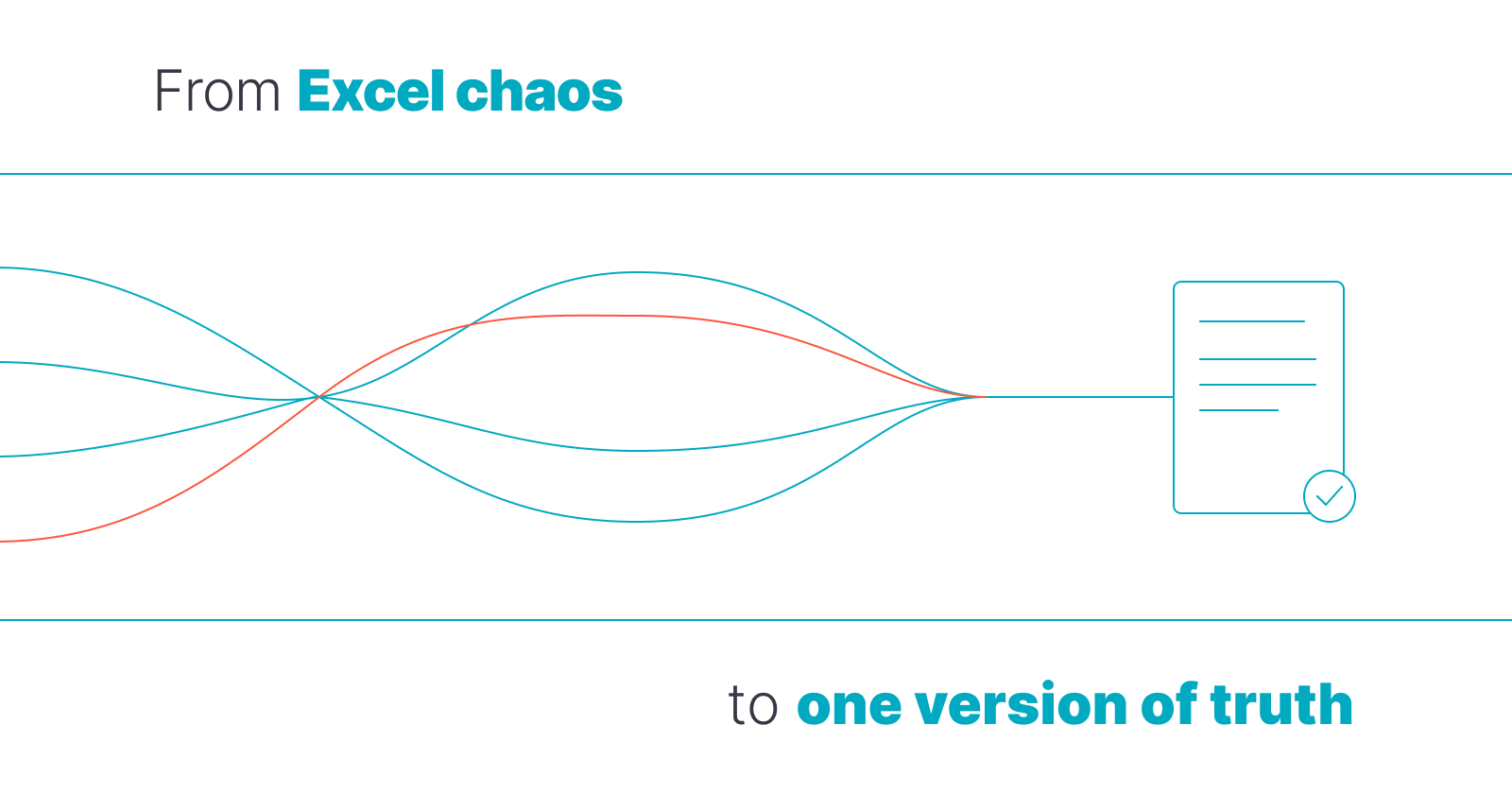
How a Megaladata-based solution reduced data mart creation time to seconds and helped establish a single version of the truth for a leading cybersecurity vendor.
The customer is a leading cybersecurity vendor with over 3 000 employees, known for products that detect vulnerabilities and block cyberattacks. By 2024, their revenue had grown 9x over five years, and their data infrastructure hadn’t kept up.
Situation before the project
The company stored information in many disconnected sources: databases, web services, and numerous Excel files that had accumulated in different departments over the years. Files, especially Excel, were a real headache. They were duplicated, lost, updated manually, and sometimes even contained contradictory data. No one could guarantee two departments would produce the same numbers. Managers spent hours tracking down data and reconciling it manually.
Meanwhile, the business was growing rapidly, increasing its revenue and expanding the customer base. Processes and the organizational structure became more complex along with it. The company updated its CRM, but the data remained in isolated systems. Under the increased load, reports came late, and their accuracy depended on whoever had assembled them. If management needed a prompt answer, analysts had to export data from several systems manually, combine it in spreadsheets, and only then build visualizations.
Naturally, the company needed one system to collect data from all sources automatically, check its quality, and deliver accurate analytics without manual work.
Solution
To centralize data and automate processes, the team chose the Megaladata platform for its convenient visual interface and flexibility in adjusting to a broad range of self-service analytical tasks. Also, starting work quickly with minimal development costs was critical, as the team at the start of the project consisted of only three people – one data specialist and two analysts. Megaladata let the team launch pilots quickly and get working results without lengthy infrastructure setup and writing a large amount of code.
The overall architecture of the solution was planned as follows:
- Data extraction: Megaladata
- Data storage: a fault-tolerant cluster system (ClickHouse was chosen)
- Data mart: a BI system for advanced visualization
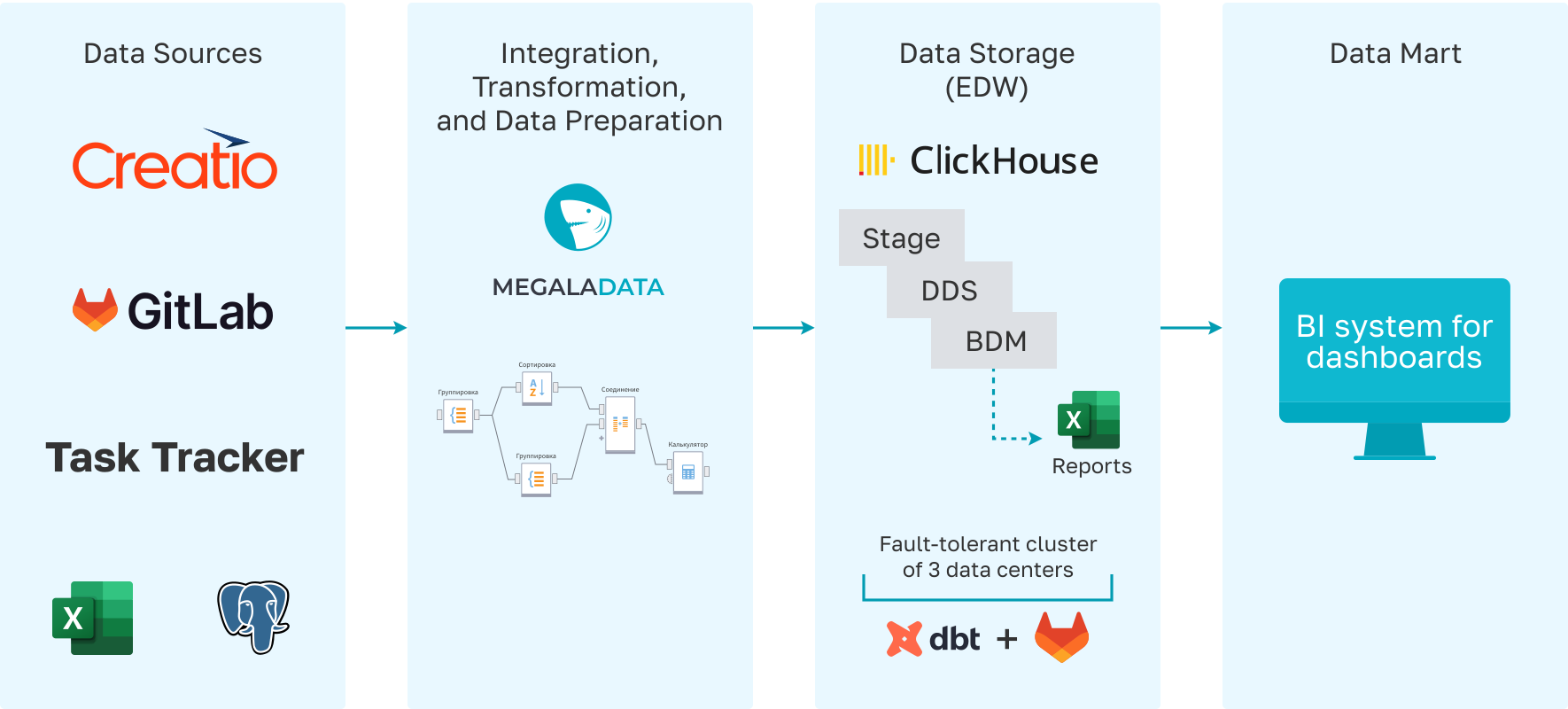
Using Megaladata for data extraction from different sources
Loading user files
The system processes files with a typical algorithm. The user uploads the file to their folder in the network file storage.
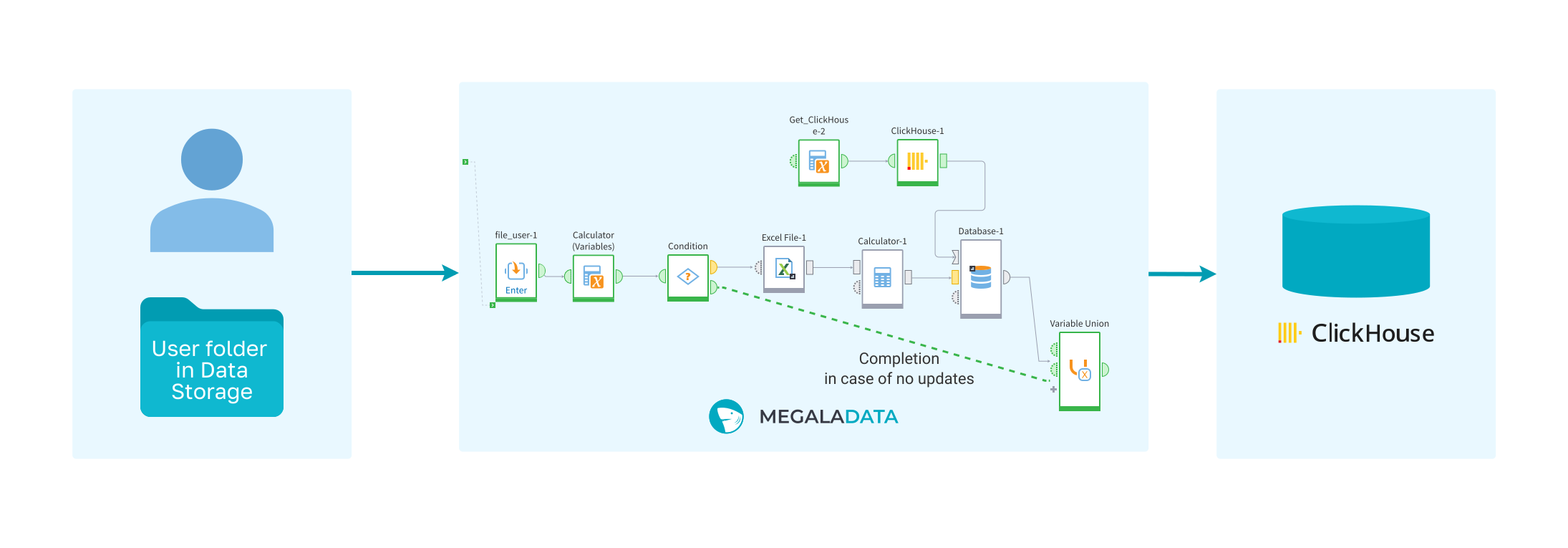
On a schedule, the system checks this folder and determines whether it has changed. If the file has changed, the algorithm loads it; if not, it moves on to the next file. Then, the system saves the received data to ClickHouse.
Loading data via REST API
Megaladata performs REST API interaction as one loop iteration.
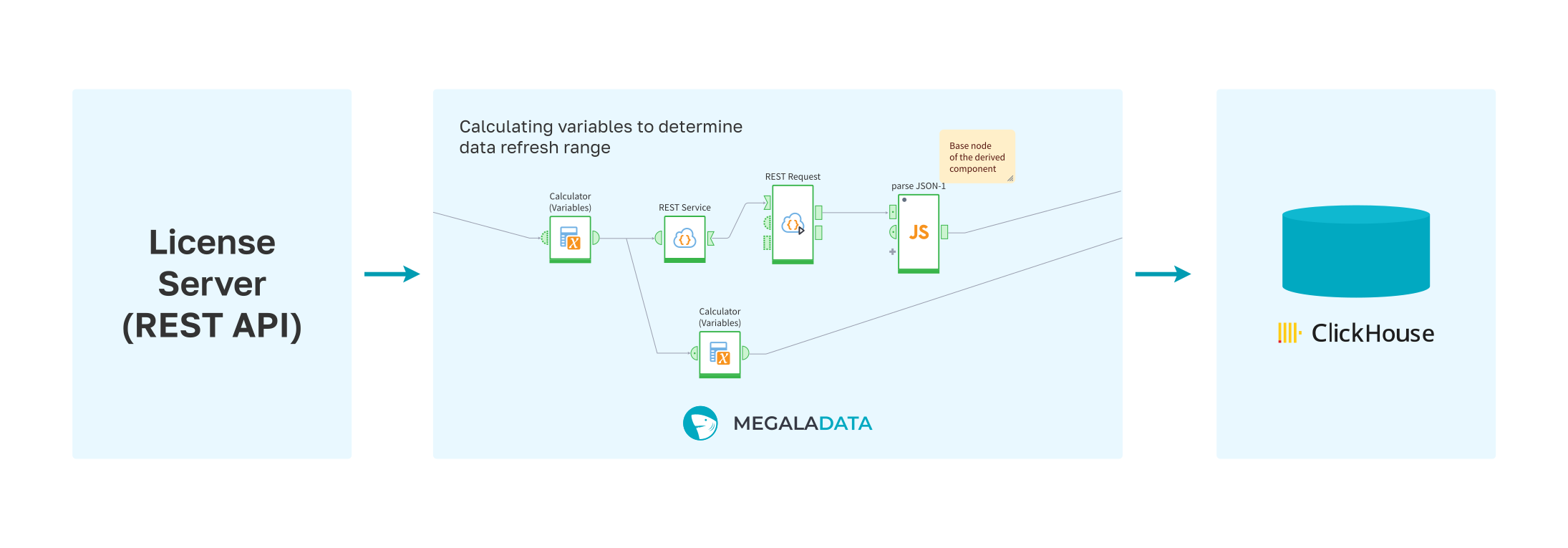
At the input, the system receives parameters, calculates connection data, and sends a request to the service. It parses the JSON response into a flat table, then determines the pagination parameter: if needed, it starts the next iteration; otherwise, the loop ends. At the output, the system generates the final table and saves it to ClickHouse.
Loading from Creatio CRM (MS SQL database)
Megaladata uses Creatio CRM (an MS SQL database) as the data source.
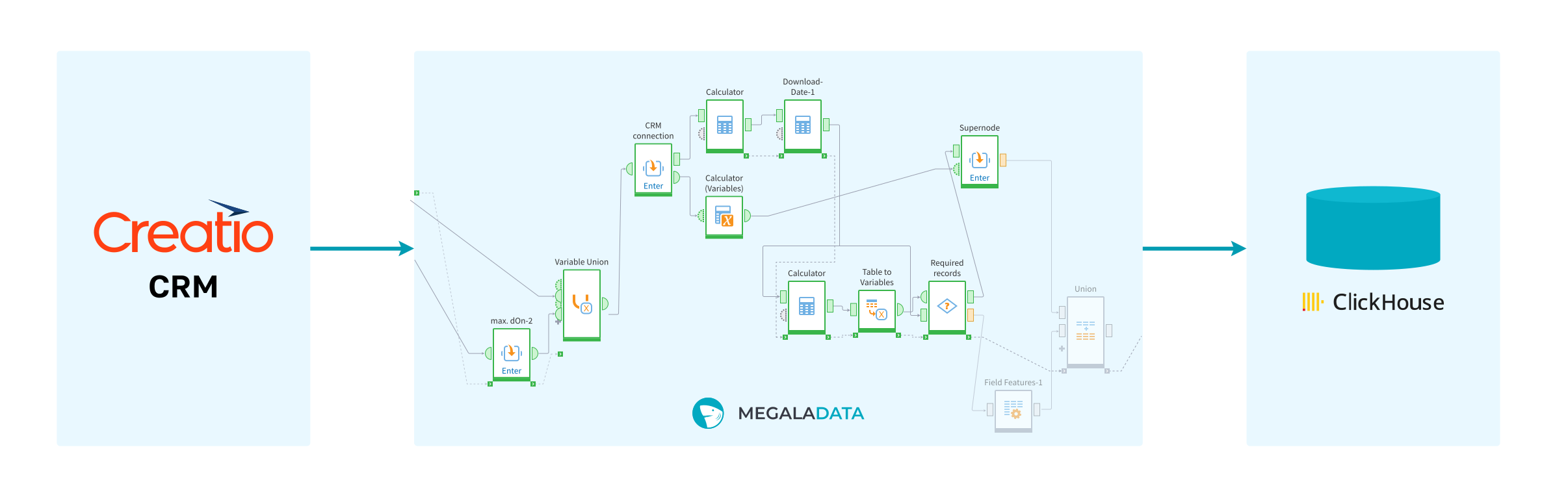
The input is the name of the source table. Based on it, the system calculates the increment; in this case, the maximum update date available in the destination (ClickHouse). Then, it filters out invalid records and generates the target table according to the standard workflow.
If the system cannot obtain the increment, the workflow stops processing. If it obtains the increment successfully, it analyzes the data, filters incorrect values, identifies the target table, and then loads the information into ClickHouse. All operations run automatically within the preset algorithm
Results
The project showed that even a large and complex business can quickly bring order to its data if it chooses the right tools and is willing to automate routine work.
Speed
- Data marts are built in 5 seconds; previously this took hours or even days. That is, speed increased at least 1 440 times.
- Thanks to the new approach, connecting a data source dropped from weeks to one day, accelerating about 14 times.
Quality
- With Megaladata, the team created a cohesive system that automatically collects data from all sources, checks its quality, and provides management with accurate analytics in real time.
- A single version of the truth: there are no longer discrepancies between departments.
- Automatic control ensures the consistency and quality of all Excel files, as the system monitors the format.
Scalability
- 150+ users work with the platform within the company, and this number is growing.
- The system scales easily and lets the team connect new sources quickly.
Implementing Megaladata enabled a reliable data infrastructure, reduced time spent on data processing, and provided management with up-to-date, verified analytics. This is an example of a successful implementation during a period of company growth and increasing data complexity.
Further reading:
See also

Responsible AI Use in Analytics: What It Actually Requires at Enterprise Scale
Automation and Data Analysis with Megaladata at a Large Industrial Enterprise
A large mining and metallurgy plant with 65,000 employees runs every stage of production, from raw material extraction to manufacturing. The company came to Megaladata with two problems: warehouse...
Introducing Mega AI Agent
You describe the task. Mega AI Agent builds the full workflow in Megaladata – every calculation, filter, and data join visible from the first step, ready to inspect, edit, and rerun.
About Megaladata
Megaladata is a low code platform for advanced analytics
A solution for a wide range of business problems that require processing large volumes of data, implementing complex logic, and applying machine learning methods.
GET STARTED!
It's free