
A large telecom operator unified dozens of disparate data sources into a single system on Megaladata. Information processing time dropped from several days to hours: a 3-5 times speedup. More than 300...
Low-Code for Creating Digital Twins

Creating "virtual twins" of business processes and objects helps deeper understanding and drives better management. In this article we explore how low-code approach facilitates the development of such systems.
Since the mid-2010s, interest in digital twins has grown across many industries. A digital twin (DT) is a virtual copy of a physical object, system, or process. Teams build them to monitor and forecast an object's state and to manage processes better without interfering with the structure or operation of the original.
Digital twins come in several forms, such as: digital twin prototype (DTP), digital twin instance (DTI), digital twin aggregate (DTA), and intelligent twins. The field still lacks shared standards, though useful development guidelines do exist.
Where digital twins are used
Digital twin technology is widely used to track and forecast the condition of industrial machines and similar heavy equipment.
Example case: a digital twin was built for a crane to monitor its condition and predict future performance over time. The team built a digital model of the structure and monitored crane node parameters with strain gauges. Combined with real-time sensor data, the digital twin helped watch the crane's state closely and anticipate material fatigue.
Fields like medicine rely heavily on visual models. For example, organ models built from tomography help surgeons coordinate during procedures. These tools already improve treatment and support remote medical consultations. Strictly speaking, though, they are not digital twins.
A virtual model of a specific person, rather than a generic human body, is an appealing idea that many papers have explored. Being able to forecast health-related events such as nutrient deficiencies, tissue and organ decline, and the outcomes of medical interventions, would matter a great deal. A human digital twin would need to combine anatomy and physiology - blood test results and similar data - and predict important changes and treatment effects. However, real breakthroughs in human digital twins remain rare. The same is true in other areas where people try to model truly complex systems.
Why is this hard?
Building and deploying digital twins raises many challenges, from the nature of the object being modeled to the compute power available. The main obstacles are:
- The object itself is complex. Modeling a crane is already feasible. The model can mirror the real machine well and produce solid forecasts. Modeling a living person is far harder: there are many more parameters, and many more sophisticated connections between them.
- Experts are not involved enough. A twin of a specialized object needs domain experts. In some areas, those experts rarely have the technical skills required to work with a digital twin.
- Data processing is too slow. Models with many parameters often run slowly. If the twin takes longer to calculate while you have to act quickly on the real object or process, the model loses its value.
How low-code helps
Low-code platforms address some of these issues. A strong example is the Megaladata use case: Digital Advisor for a steel mill. The Megaladata low-code platform helped solve furnace control issues for an electric arc melting furnace.
Here are some project details.
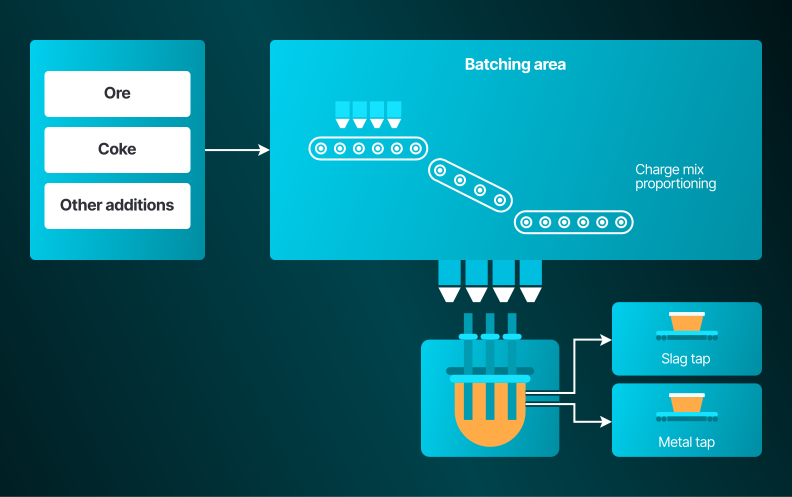
Electric arc melting furnace schematic
Inside the furnace, several tons of raw material melt into the alloy.
The standard control system could not manage the melting process tightly enough. An optimal melt takes about two hours. Process issues, such as a poor melt composition or imprecise electrode positioning, sometimes stretched that time several times over, which led to serious losses.
A skilled process engineer can handle these melting nuances, but such specialists are scarce and cannot watch every unit around the clock.
Our team joined forces with the customer's experts to develop a three-part solution: a furnace digital twin, an optimal melting scheme, and a recommendation system for process optimization. Megaladata's low-code structure allowed the company's process engineers to take active part in the development, providing the recommendations directly. They could apply their field expertise, modelling the data logic visually - with no need to write code.
The digital advisor for the electric arc furnace improved production results. The plant could detect unit states automatically, fix problems in hours instead of days, and save electricity and melt components. Over five months, the plant's output rose by 3%.
Bottom line
Digital twin development is a promising field, but it still faces real barriers - from weak technical support for processes to the lack of expert involvement.
Low-code systems are one of the most promising ways forward. They bring domain experts into twin development not only as advisors, but as true participants.
After a low-code project ends, an expert can review how the system behaves and adjust it without waiting for programmers. That raises engagement and improves model quality.
With better methods and more automation for domain specialists, effective digital twins become realistic even for highly complex systems. Before long, we may see human DTs that help predict health issues and plan complex medical interventions, along with ecosystem DTs that support stronger environmental protection.
More Megaladata use cases:
See also
Megaladata as an Automation Tool: Case Study
How an E-commerce Retailer Reformed Replenishment in Three Months: Case Study
Replenishment planning for a large retailer means constant change: new seasons, new vendors, new regions. Every update used to mean a ticket and a wait. Here is what happened when they added Megaladata....

Semantic Layer
Large volumes of complex information force analysts to focus more on data management tasks than on data analysis. A specialized mechanism named "semantic layer" solves this problem. It provides a business...
About Megaladata
Megaladata is a low code platform for advanced analytics
A solution for a wide range of business problems that require processing large volumes of data, implementing complex logic, and applying machine learning methods.
GET STARTED!
It's free