
There's a version of this conversation that stays theoretical – data quality matters, governance is important, AI needs the right context. Everyone agrees.
When Not to Use AI in Analytics
The question most companies are asking is: “How do we integrate AI into our analytics?” The better question is where they shouldn't.
Not because AI is overhyped. Because the situations where it fails aren't obvious until they're expensive. In analytics, the most dangerous failure isn't always a crash. Sometimes the system keeps running, and the numbers are just slightly wrong.
The case that makes this concrete
A large holding company operates across multiple systems. On paper, they know what's in their warehouses. In practice, they lose millions of dollars every month buying stock they already own, because nobody can tell it's the same item.
The problem: A pipe fitting is listed one way in one database, another way in another, and yet another way in a third, across three languages and multiple alphabets. The same physical object is completely unrecognizable across systems.
The fix requires master data management: a canonical reference broken down by attributes like material, diameter, standard, coating, and length. Once you have that, you can find substitutes, compare suppliers, and optimize inventory. Without it, your warehouse is a black box.
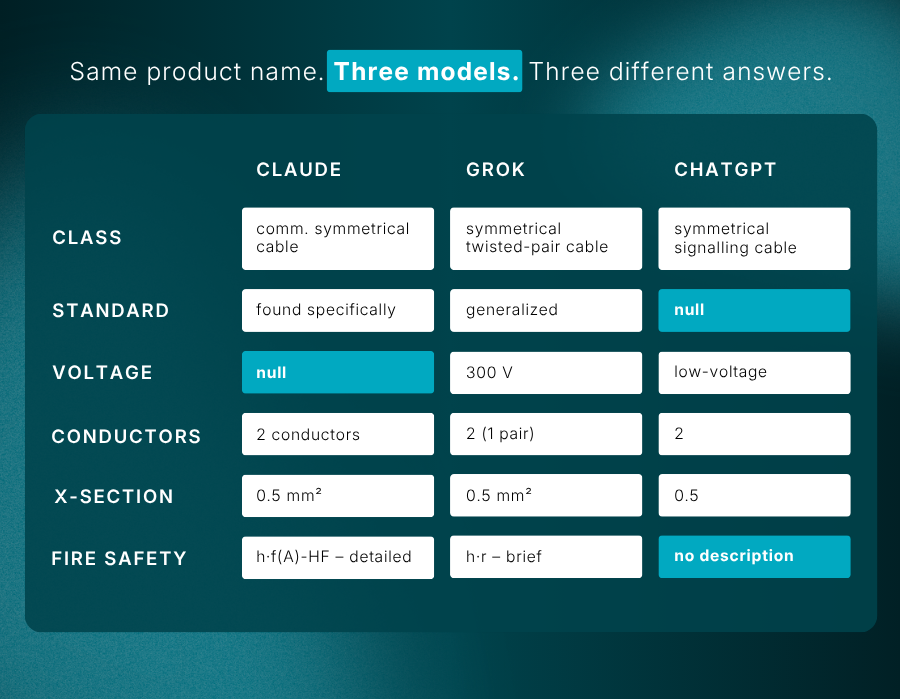
Can AI solve this? Ask an LLM to parse a product name into its component attributes, and it will produce a result. The problem is that different models produce different results for the same input, and all of them look plausible. You don't know which one to trust. Different models can produce different interpretations of the same input, with no reliable basis for deciding which one should become part of the business logic.
Why AI in analytics is dangerous
The risks aren't theoretical. They show up in everyday decisions. A flawed insight here, a biased recommendation there, and before long decisions are being made on outputs nobody can trace, from systems nobody fully controls.
AI generates the most likely answer, not the correct one. In analytics, that gap is invisible – the output looks credible, lands in a report, and a decision gets made before anyone questions it. Models are also trained on historical data that isn't neutral. Feeding in your own enterprise data doesn't fix that. Skewed assumptions persist, quietly shaping recommendations.
Then there's traceability. AI produces an answer without explaining how it got there. If you can't trace the logic, you can't verify it, defend it, or trust it will hold up next time. Autonomous systems don't pause to check whether the data they're acting on is reliable. And some of those actions are easier to trigger than to undo. Earlier this year, AI was caught citing LinkedIn posts as sources.
There's also the data exposure question. Many AI tools learn from what you feed them. If that includes customer records or proprietary business logic, you may be leaking sensitive information without knowing it. Add prompt injection, manipulated inputs, and model spoofing to the list, and introducing AI into your analytics stack without taking security seriously leaves the door open to malicious intent.
In analytics, wrong answers don't just sit there. A flawed insight becomes a slide deck. A slide deck becomes a strategy. A strategy becomes a budget decision. By the time the error surfaces, it's a business problem.
Three questions to ask before using AI in any analytics workflow
At Megaladata, we use a simple framework to decide where AI belongs and where it doesn't.
- Error cost. In testing, a failed test tells you something went wrong; you fix it and run again. In a core data pipeline feeding a bank's decision systems, an error doesn't raise a flag. It propagates silently. By the time anyone notices, the cost is measured in millions per day.
- Task predictability. AI performs well on tasks that follow recognizable patterns such as writing test cases, generating standard dashboards, and structuring product descriptions. Core business logic is the opposite. It's specific to your company, your contracts, your regulatory environment, your data history. There are no training examples for your exact churn definition or inventory methodology. The more unique the task, the more confidently wrong AI can be.
- Data sensitivity. A test suite can be published with no risk. The logic that determines how your company calculates revenue, risk, or client value is a different matter. That's years of accumulated business knowledge embedded in systems. Feeding it into an external model isn't just a technical risk. It's an intellectual property risk.
The skill problem nobody is talking about
The first few times an analyst uses AI, the experience is impressive. A report appears in seconds. A query writes itself. A summary sounds convincing. Do that often enough and something quietly shifts. The analyst stops asking "is this correct" and starts asking "does this look right". Those are very different questions, and the distance between them is where analytical judgment lives.
Good analysts stand out for skepticism. They challenge assumptions, chase inconsistencies, and pay attention to numbers that don't fit the pattern. AI can reduce the friction that forces people to think critically. When an answer arrives instantly and sounds convincing, verification starts to feel optional. Over time, that can weaken the habit of questioning.
This is where AI starts to resemble fast food. It’s useful when you're travelling, working late, or simply don't have another option. The problem begins when convenience overtakes necessity.
Using AI to accelerate repetitive work is genuinely valuable. Letting it become the default way of reasoning is a poor substitute for the habits that make analysts effective in the first place.
AI is a material, not a solution
Materials such as wood, steel, concrete, or glass each have different properties, and none is inherently better than the others. You don't build a bridge out of paper because paper is cheap and easy to work with. You choose the material whose properties match the demands of the structure.
AI works the same way. It's fast, pattern-driven, creative, and probabilistic. Those properties make it exceptionally good at some tasks and completely unsuitable for others. The companies getting the most from AI in analytics are the ones that understand their workflows well enough to know which problems benefit from AI and which require deterministic logic.
The question worth asking
Before adding AI to any analytics workflow, one question matters: “What happens when it's wrong, and will I know?”
- If the cost is low and the error surfaces quickly, use AI.
- If the cost is high and the error might stay invisible for weeks, build the deterministic system first. AI can assist at the edges, but it shouldn't own the critical path.
The goal isn't to use AI as much as possible. It's to make better decisions faster. Sometimes those are the same thing. Often, they're not. Because in analytics, the hardest part isn't producing an answer. It's knowing when not to trust one.
See also

How to Build a Data Workflow That AI Can Actually Trust

How To Use Execution Order Ports When Running Megaladata Workflows
Megaladata automatically optimizes workflow execution: It runs only the nodes linked by a data chain and uses parallel computing. However, in some cases, you may need to set the execution order manually. You...

1 TB in Under 13 Minutes: Performance Test Report
For this test, we ran Megaladata 7.3.3, importing 1 TB from two production DBMSs simultaneously, with transformations applied, over a standard cloud network. Five consecutive runs. Average: 12 minutes...
About Megaladata
Megaladata is a low code platform for advanced analytics
A solution for a wide range of business problems that require processing large volumes of data, implementing complex logic, and applying machine learning methods.
GET STARTED!
It's free