
There's a version of this conversation that stays theoretical – data quality matters, governance is important, AI needs the right context. Everyone agrees.
MCP – The Model Context Protocol for AI

AI models often rely only on training data, resulting in generic, unrealistic responses. MCP technology addresses this by integrating multiple context sources, both internal and from the business environment.
The core problem: AI without context
Think of these examples:
- A lost driver asks a passerby, "Where am I?", and gets the reply, "In a car." Technically correct, but useless.
- A business asks an AI, "How do I increase profits?" and receives, "Reduce costs and raise prices." Again, technically correct but meaningless, what matters is how to do it.
AI needs context: access to real-time data from databases, CRM systems, internal documents, and market trends to provide actionable answers.
The old approach: Ad-hoc solutions
Traditionally, businesses built custom connectors and tools to feed AI context. However, this method has flaws:
- Time-consuming: Delays in decision-making can mean missed opportunities or unmanaged risks.
- Incompatible: Multiple data sources require multiple, often clashing solutions.
- Rigid: Adding or changing data sources means rewriting code.
The modern way: MCP (Model Context Protocol)
Developed by Anthropic in 2024, MCP is an open standard for connecting AI applications to external systems. Think of it as a USB port for AI: a universal way to plug into databases, APIs, files, and tools.
Key principles of MCP
- Universality: A single protocol for all models and environments.
- Extensibility: Supports new data sources and tools.
- Transparency: Open specification and free implementations.
MCP architecture
MCP uses a client-server model:
- MCP host: The AI application (e.g., Claude Desktop, VS Code) that manages connections to MCP servers.
- MCP client: A component that connects to an MCP server and retrieves data for the host.
- MCP server: A program that provides context (e.g., a database, file system, or GitHub repo) to clients.
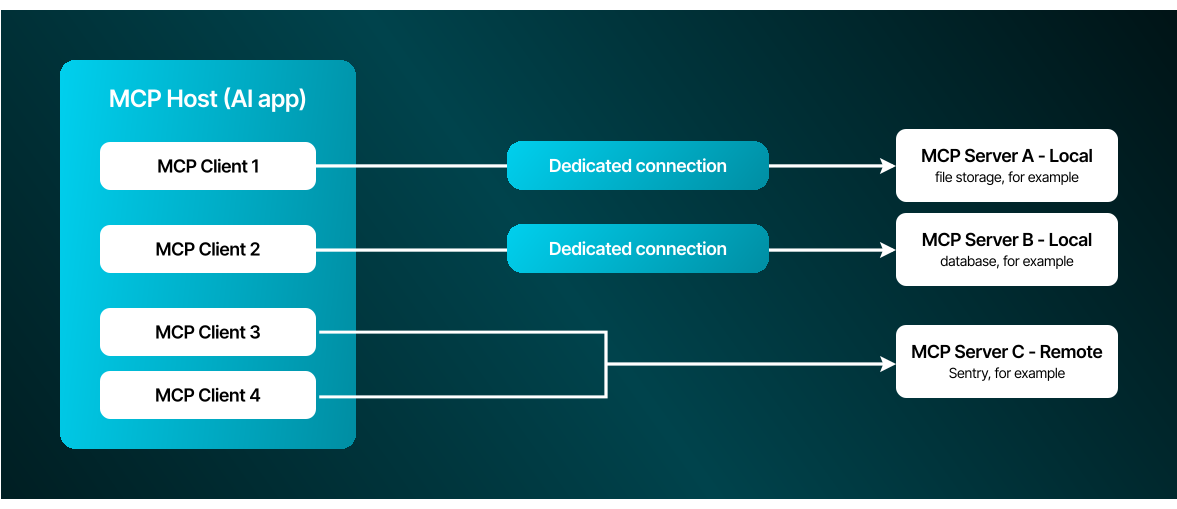
MCP architecture
Two layers of MCP
-
Data layer
- Implements a JSON-RPC 2.0 protocol for communication, defining the structure and semantics of messages.
- Includes:
- Connection lifecycle management, which initializes connections between clients and servers, ensures collaboration, and terminates sessions.
- Server functionality, which enables servers to provide:
- Tools for executing actions.
- Resources for contextual data.
- Prompts for client-to-server and server-to-client interaction patterns.
- Client functionality, which allows servers to:
- Request data from the client for retrieval from the host.
- Receive user requests.
- Send messages to the client log.
- Helper functions, which support real-time notifications and progress tracking for long-running operations.
-
Transport layer
- Manages communication channels (e.g., stdin/stdout for local processes or HTTP streaming for remote servers) and authentication (OAuth recommended).
- Establishes connections, formats messages, and secures communication between MCP session participants.
- Supports two data exchange mechanisms:
- Standard I/O transport, which uses standard I/O streams for direct communication between local processes, providing optimal performance without network overhead.
- HTTP message streaming, which uses HTTP POST to send messages from the client to the server, with the option to stream via server-sent events. Supports standard HTTP authentication methods (tokens, API keys, and custom headers).
Key notes:
- The data layer protocol is the core of MCP, defining how context is exchanged between servers and clients.
- MCP uses JSON-RPC 2.0 as the underlying RPC protocol. Clients and servers send requests to each other and respond accordingly. When no response is required, notifications (sent as JSON-RPC 2.0 messages) enable real-time updates, such as tool changes or dynamic modifications.
MCP servers: The power of integration
An MCP server provides AI with context and capabilities via standardized interfaces. Examples:
- File servers (access to documents).
- Database servers (SQL queries).
- GitHub servers (code development).
- Megaladata servers (intelligent data analysis).
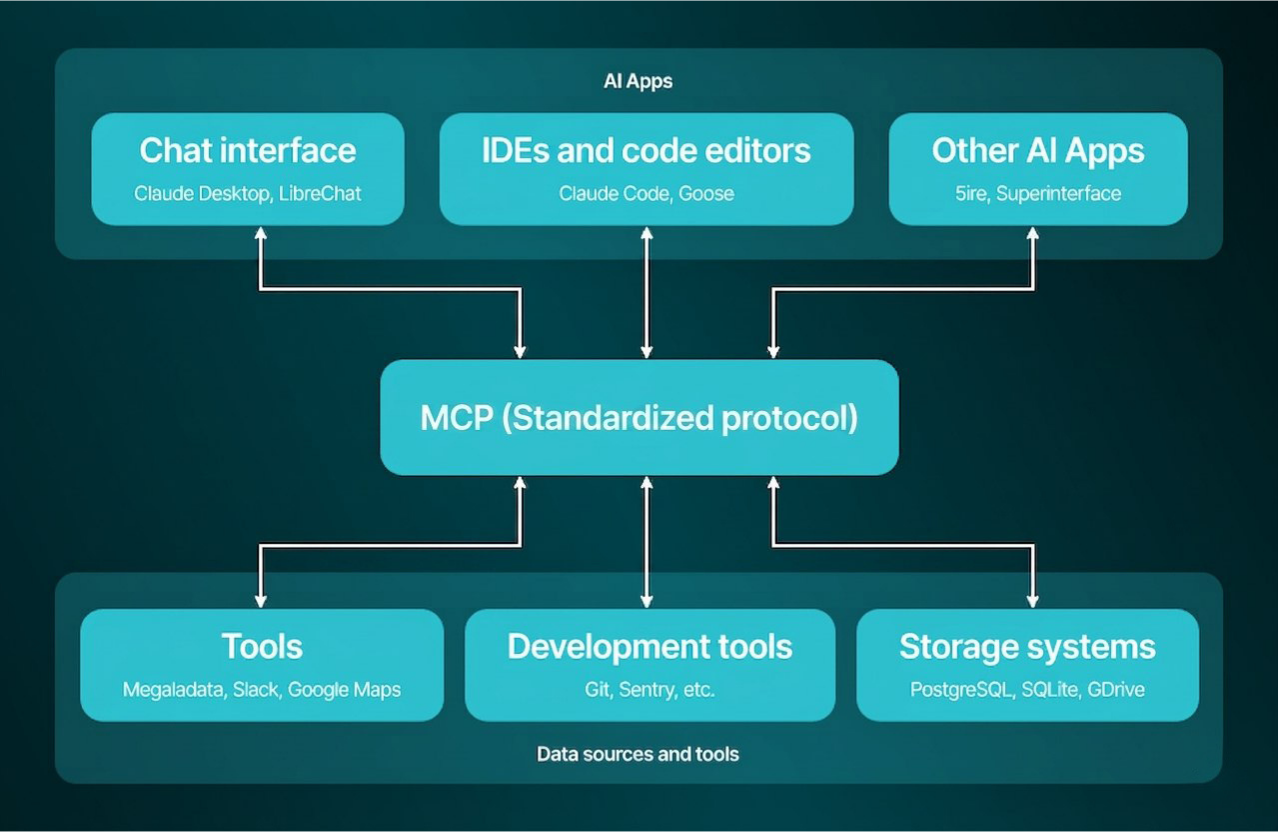
Connections to MCP
Server primitives (building blocks)
MCP servers provide three core primitives:
-
Tools: Executable modules AI can invoke based on user requests (e.g., write to a database, call an API, or edit a file). To ensure user control, hosts can require approval before execution.
-
Resources: Read-only data sources (e.g., files, databases) to provide context. Each has a unique URI (e.g.,
file:///path/to/document.md) and MIME type. Users interact via:- File browsers
- Search/filter interfaces
- AI-driven context suggestions
-
Prompts: Predefined templates for common interactions (e.g., "Summarize this report using data from X and Y").
MCP clients: Bridging AI and servers
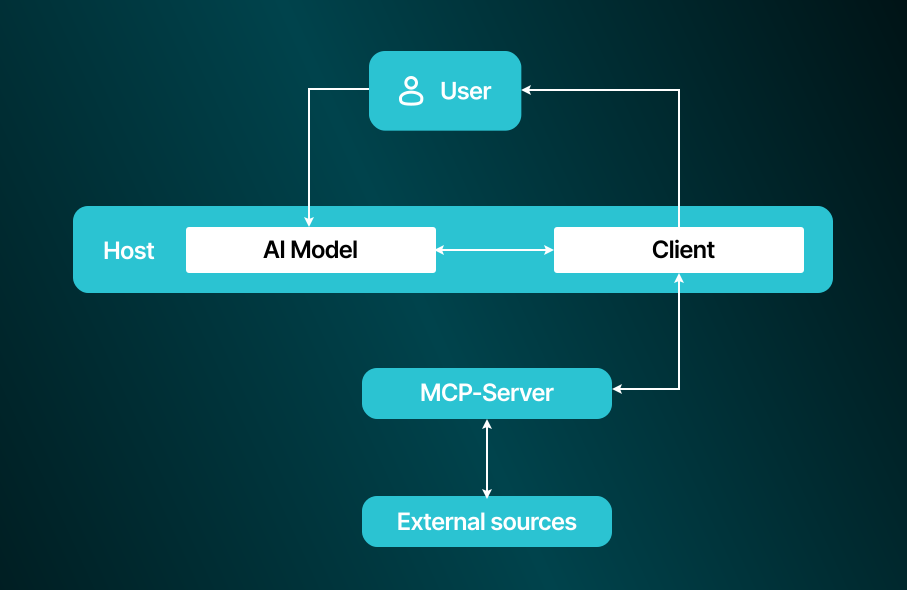
MCP host
- Host applications (e.g., Claude.ai, IDEs) create clients to connect to MCP servers.
- Clients enable advanced interactions via:
- Elicitation: Servers request missing data from users dynamically (no more errors for missing info).
- Root directories: Set file system boundaries for servers (e.g.,
file:///home/user/projects). - Sampling: Servers request AI-generated text (e.g., summaries, translations) from the host’s LLM, offloading heavy text-generation tasks.
Why MCP matters: Key benefits
- Unification: Standardizes AI interactions with external systems, ending fragmentation.
- Efficiency: Reduces redundant development and improves tool quality.
- Real-world relevance: AI accesses live data, not just static training sets.
- Flexibility: Open protocol avoids vendor lock-in.
Use cases for MCP
MCP enables AI to dynamically pull context for real-world applications:
| Industry | Example Use Case |
|---|---|
| Business analytics | Keep customer segmentation models updated with fresh CRM/sales data. |
| Credit scoring | Pull real-time borrower data and economic indicators (interest rates, exchange rates). |
| Dynamic pricing | Adjust discounts based on customer history, demographics, and inventory data. |
| Marketing | Generate personalized campaigns using CRM and behavioral data. |
| Customer support | Send AI-generated voice messages for natural interactions. |
| Software development | IDEs (e.g., VS Code) provide context-aware code suggestions. |
| IoT | AI manages physical devices via standardized interfaces. |
| Multi-agent systems | Coordinate multiple AI agents to solve complex tasks. |
Conclusion: MCP as the future of AI integration
MCP transforms large language models from isolated knowledge bases into active participants in workflows. By standardizing how AI interacts with external data, MCP ensures:
- Lower development costs
- Expanded AI capabilities
- Actionable, context-aware solutions
Further reading:
See also

How to Build a Data Workflow That AI Can Actually Trust
How To Use Execution Order Ports When Running Megaladata Workflows
Megaladata automatically optimizes workflow execution: It runs only the nodes linked by a data chain and uses parallel computing. However, in some cases, you may need to set the execution order manually. You...
1 TB in Under 13 Minutes: Performance Test Report
For this test, we ran Megaladata 7.3.3, importing 1 TB from two production DBMSs simultaneously, with transformations applied, over a standard cloud network. Five consecutive runs. Average: 12 minutes...
About Megaladata
Megaladata is a low code platform for advanced analytics
A solution for a wide range of business problems that require processing large volumes of data, implementing complex logic, and applying machine learning methods.
GET STARTED!
It's free