
There's a version of this conversation that stays theoretical – data quality matters, governance is important, AI needs the right context. Everyone agrees.
When to Avoid AI in Business Analytics: Counter-Examples

While many resources explain how to use artificial intelligence (AI) in business analytics, it is just as important to recognise the tasks where AI, especially large language models (LLMs), is either ineffective or inappropriate. In academia, AI and LLMs are not synonymous; AI is a far broader field. However, LLMs have proven so versatile that, in practice, most people equate AI with LLMs. For simplicity, this article uses the terms interchangeably.
Like all machine learning models, LLMs operate by calculating probabilities. They train on specific datasets, develop methods for processing information, and then apply those methods to new data. In simple terms, they "guess" the most likely solution. Crucially, LLMs are black boxes: users cannot see how they reach decisions, they only see the output.
In some cases, such as normalizing text after optical character recognition, this approach is not just acceptable but highly effective. (For examples of where LLMs excel, see the article 5 Practical Ways to Use AI in Data Management.) However, there are five notable issues where using AI in its "pure" form is not advisable.
Rule-based processing risks
If a task follows predefined logic, such as calculating metrics using fixed formulas, complying with legislation, or applying business logic, AI is unnecessary and risky.
- Why? While an LLM might select the correct calculation method, it could also make a costly error.
- Example: Calculating tax deductions or inventory thresholds. You could deploy an entire infrastructure and query an LLM… or simply use a calculator or a script. This is an extreme example, but many real-world requests are similarly straightforward.
- Key issue: Over-engineering, creating an unnecessarily complex solution where a simpler, cheaper, and more reliable one exists.
- Critical case: Legal rules (e.g., product return deadlines, restrictions, exceptions). Here, "probabilistic deviations" are unacceptable, as errors lead to financial losses or legal risks.
Solution: If the logic is known, implement it directly. It’s faster, cheaper, and more reliable.
Transparency requirements: The problem with black boxes
LLMs lack inherent transparency. While tools like chain-of-thought prompting or explainability frameworks can provide partial insights, their reasoning remains largely opaque. They provide outputs without:
- Guarantees of reproducibility
- Transparent logic
- Consistency (today’s answer may differ from tomorrow’s).
Why this matters in business analytics:
- You must understand how results are obtained.
- You need to explain conclusions to colleagues, management, or auditors.
- Reproducibility is non-negotiable.
- Confirmation bias is a risk: Users may unconsciously favor AI outputs that align with their pre-existing beliefs, especially when the reasoning is unclear.

Example
Think of determining a discount rate for a counterparty. Using an LLM for this would raise immediate questions. People may dislike business rules, but they accept them because they are explainable. AI-driven decisions, however, are opaque, leading to distrust and conflicts.
Workaround?
Methods exist to track LLM reasoning and assess model quality, but they require additional effort. In most cases, simpler solutions suffice.
High cost of error: Who takes responsibility?
When the cost of error is low, minor inaccuracies may be tolerable. But in fields like medicine, law, or strategic management, the stakes are far higher.
The core question: Who is accountable?
- AI can recommend, suggest, or analyse, but it cannot bear legal responsibility, pay fines, or answer for consequences.
- LLMs are not legal entities. Ultimately, humans or companies must assume liability.
Counterargument: Isn’t this just "fear of machines"?
- No. We already trust technology with critical functions (e.g., car safety systems).
- But: Autonomous vehicle systems are certified, their logic is transparent, and safety mechanisms (beyond LLMs) are in place. Most importantly, accountability is clear in negative scenarios.
Limitations on large data volumes
Myth: "Since LLMs can 'answer any question', you can just feed them a large dataset and get results."
Reality:
- Slow: LLMs are not optimized for processing large datasets.
- Expensive: Using them requires either powerful infrastructure or high token costs.
- Inefficient: Far better tools exist for this purpose.
Key point: Big data technologies emerged because datasets often exceed the memory of a single computer. Most LLMs have limited context windows (e.g., 32K–1M tokens), making them impractical for datasets with millions of rows. Tasks that take seconds in BI systems (or even Excel) become slow and resource-intensive with AI.
Solution: Use specialised tools for large datasets. For LLM integration, MCP (Model Context Protocol) is effective. For example, Megaladata's MCP server allows processed data to be fed to LLMs efficiently.
Economic inefficiency
AI is expensive. Costs include:
- Hardware purchases
- Infrastructure setup
- Energy consumption
- Cloud service fees
Comparison
Simple solutions on low-cost hardware (e.g., Arduino, Raspberry Pi) solve many tasks effectively and cheaply. These are popular in smart home systems because they are affordable and adequate.
Self-hosting LLMs or using high-end APIs, by contrast, can be costly, though lightweight or open-source alternatives may offer cost-effective solutions for specific use cases.
Technology evolves rapidly. What is expensive today may become mainstream in a few years. But as of 2026, AI is economically unjustified for many small-scale or low-complexity tasks.
Additional concern: Security
- Cloud-based LLMs introduce security risks, especially if sensitive data is shared with third-party providers.
- Many employees use external LLMs for work tasks, risking data leaks.
- Local models are an option but require significant investment in deployment and maintenance.
Bottom line: Key limitations of AI in business analytics
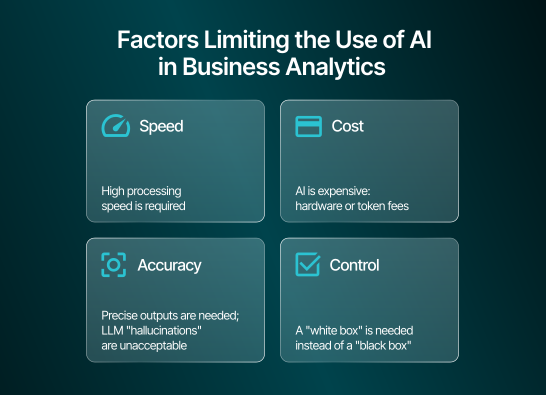
Factors limiting the use of AI
Note that this critique targets standalone LLMs, not AI as a whole. LLMs can still be valuable for:
- Content generation
- Assistive tools
- Complex systems with additional oversight
This article aims not to dismiss AI but to prevent misuse and unrealistic expectations. Users often hope for "magical" results, waste time and money, and then reject the technology entirely due to poor implementation. This must be avoided.
Final note
Use LLMs where they excel. For data, use the right tools.
And remember: Trust your money and processes to understandable and predictable systems.
Further reading:
See also

How to Build a Data Workflow That AI Can Actually Trust

How To Use Execution Order Ports When Running Megaladata Workflows
Megaladata automatically optimizes workflow execution: It runs only the nodes linked by a data chain and uses parallel computing. However, in some cases, you may need to set the execution order manually. You...

1 TB in Under 13 Minutes: Performance Test Report
For this test, we ran Megaladata 7.3.3, importing 1 TB from two production DBMSs simultaneously, with transformations applied, over a standard cloud network. Five consecutive runs. Average: 12 minutes...
About Megaladata
Megaladata is a low code platform for advanced analytics
A solution for a wide range of business problems that require processing large volumes of data, implementing complex logic, and applying machine learning methods.
GET STARTED!
It's free