
There's a version of this conversation that stays theoretical – data quality matters, governance is important, AI needs the right context. Everyone agrees.
Model Degradation in Machine Learning
After deploying a machine learning model, its accuracy often declines over time: a phenomenon called model degradation or AI aging. This occurs due to changes in business processes and the data they generate. This article explores the causes, consequences, detection methods, and solutions for model degradation.
Why does model degradation matter?
Machine learning models in production environments often experience a gradual decline in accuracy, leading to poorer decision-making. While models are initially trained on historical data, real-world conditions evolve, negatively impacting their predictive power.
Example:
A bank’s credit scoring model initially predicted 95% of defaults accurately. A year later, its accuracy dropped to 87% due to economic shifts and new credit risks.
Impact:
- Experimental studies have shown that up to 91% of models may degrade over time.
- Models left unattended for six months can see a 35% increase in error rates for new data.
Main causes of model degradation
1. Data drift
Data drift means changes in the statistical properties of input data. Popular drift detection methods include:
Overall, coping with data drift usually requires retraining the model on updated data.
2. Feature drift
This is a specific type of data drift, where the importance of features change independently over time.
- Example: A scoring model initially relies on income but later shifts to age and property value.
3. Concept drift
Concept drift stands for changes in the relationship between input and output variables.
- Example: A churn prediction model becomes outdated when customer behavior shifts (e.g., mobile app usage replaces website logins).
- Solution: Redesign the model or adjust feature engineering.
4. Model drift due to selection bias
Occurs when the training data fails to account for all real-world scenarios.
- Example: A consumer behavior model underrepresents older age groups, leading to biased recommendations.
5. Feedback loops
Model predictions influence future data, creating a cycle of errors.
- Example: A recommendation system trained on AI-generated answers suggests irrelevant content, causing real users to disengage.
Detecting model degradation
Monitoring methods
-
Direct performance metrics:
- Track accuracy, precision, recall, F1 score, RMSE (Root Mean Square Error), or MAE (Mean Absolute Error).
- Use real-time monitoring and segment-specific analysis.
-
Indirect performance metrics:
- Population Stability Index (PSI): Values >0.25 indicate significant drift.
- Kolmogorov–Smirnov test: Compares data distributions.
- Distribution parameters: Monitor mean, standard deviation, and quartiles.
-
Prediction distribution tracking:
- Compare model outputs in production vs. training data.
- Unstable predictions signal potential degradation.
-
Error analysis:
- Examine error types, temporal patterns, and feature-specific errors.
Types of model degradation
1. Explosive degradation
- The model performs well for a long period, then suddenly fails.
- Challenge: Difficult to predict; monitoring only confirms degradation after it occurs.
2. Gradual degradation
- Errors increase gradually.
- Advantage: Easier to track with monitoring.
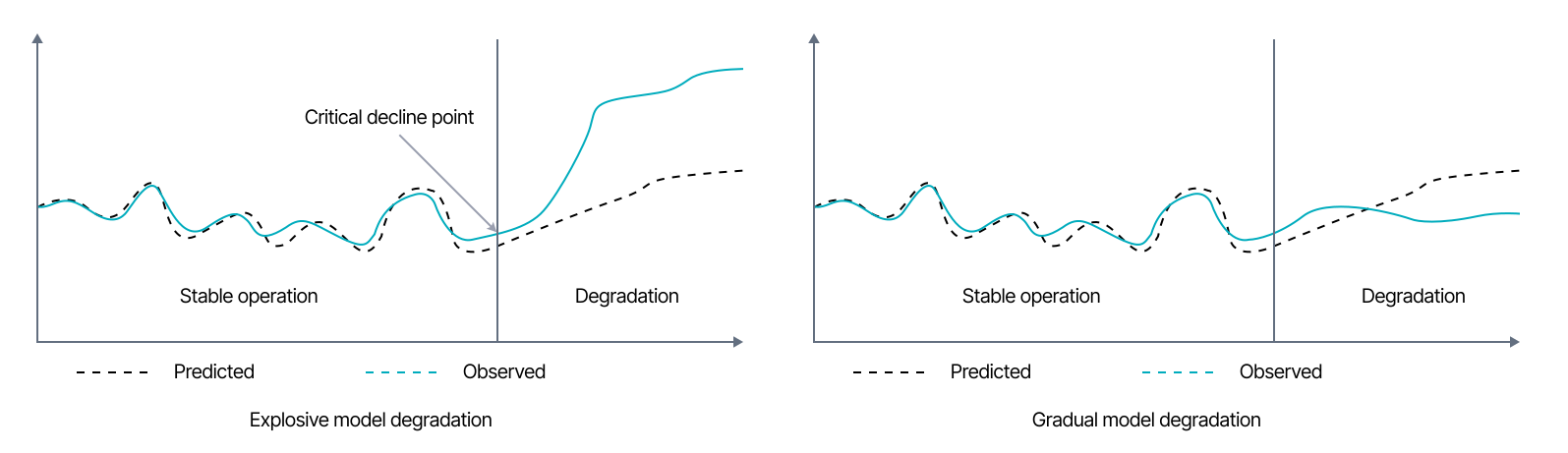
Figure 1. Types of model degradation
Solutions to combat model degradation
1. Continuous monitoring
- Track performance metrics in real time.
- Use heatmaps to visualize accuracy decline over time.
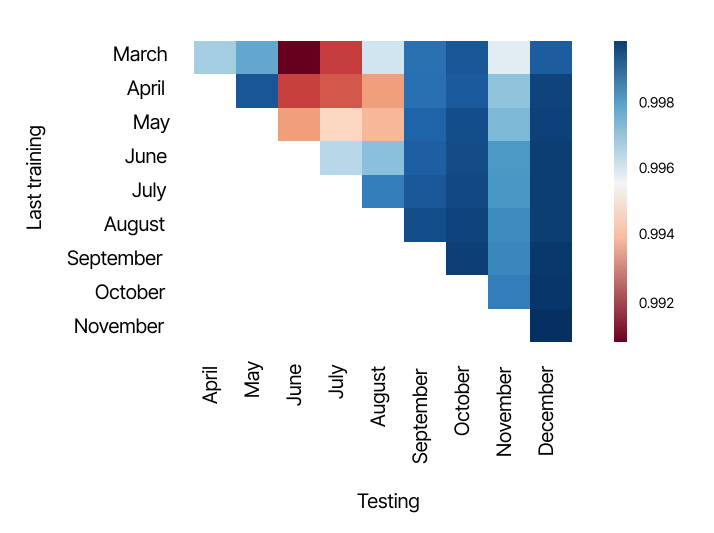
Figure 2. Example heatmap
2. Retraining strategies
- Fixed schedule: Retrain daily, weekly, or monthly.
- Event-driven: Retrain when performance metrics exceed thresholds.
- Hybrid approach: Combine fixed schedules with event-driven triggers.
3. Adaptive models
- Use ensembles of models to balance performance.
- Implement continuous learning to update models with new data.
4. MLOps technologies
- Automate monitoring, retraining, and deployment.
- Ensure representative training data and robust model validation.
Setting thresholds for monitoring
- Baseline establishment: Measure performance during a stable period (2–4 weeks).
- Cost-benefit analysis: Balance the cost of retraining against the risk of poor decisions.
- Segment-specific thresholds: Adjust thresholds for high-value segments.
Example thresholds
| Model Type | Metric | Warning threshold | Response threshold |
|---|---|---|---|
| Fraud detection | Completeness | 2% reduction | 5% reduction |
| Recommendation system | Click-through rate (CTR) | 1-2% reduction | 3-5% reduction |
| Price optimization | MAE (%) | 3% increase | 5% increase |
Retraining technologies
1. Full retraining
- Retrain the model from scratch using all historical and recent data.
- Use case: Significant concept drift or rare retraining needs.
2. Incremental retraining
- Update the model using only new data.
- Use case: Frequent retraining or limited computational resources.
3. Ensemble of models
- Maintain 2–3 models of different "ages".
- Gradually phase out outdated models and introduce new ones.
Ensuring model robustness
- Automate monitoring and retraining: Reduce manual intervention and errors.
- Comprehensive pipelines: Include data validation, retraining, evaluation, and deployment.
In conclusion
Model degradation is inevitable but manageable. By implementing continuous monitoring, adaptive retraining, and MLOps automation, organizations can maintain model accuracy and business value over time.
Read more:
See also

How to Build a Data Workflow That AI Can Actually Trust
How To Use Execution Order Ports When Running Megaladata Workflows
Megaladata automatically optimizes workflow execution: It runs only the nodes linked by a data chain and uses parallel computing. However, in some cases, you may need to set the execution order manually. You...

1 TB in Under 13 Minutes: Performance Test Report
For this test, we ran Megaladata 7.3.3, importing 1 TB from two production DBMSs simultaneously, with transformations applied, over a standard cloud network. Five consecutive runs. Average: 12 minutes...
About Megaladata
Megaladata is a low code platform for advanced analytics
A solution for a wide range of business problems that require processing large volumes of data, implementing complex logic, and applying machine learning methods.
GET STARTED!
It's free