
A large telecom operator unified dozens of disparate data sources into a single system on Megaladata. Information processing time dropped from several days to hours: a 3-5 times speedup. More than 300...
Machine Learning Model Collapse

Modern research on building and using AI models has shown that models trained primarily on content created by themselves or by other AI models gradually lose accuracy and meaningfulness, and eventually become useless. Researchers call this effect "model collapse." This article explains why it happens, what it leads to, and how you can mitigate it.
In the artificial intelligence developer and user community, it is widely known that an AI model is only as good as the data you trained it on. However, many teams have found that generative models that worked well right after deployment can degrade over time, and the degradation can vary in intensity.
Over time, model outputs become more repetitive, more error-prone, and less meaningful. A research showed that this often leads to a complete loss of model usefulness, and that it can happen for different reasons across different models. In practice, you most often see it during the training of generative AI models.
Many experts now treat machine learning model collapse as a fundamental AI problem that can negatively affect AI development worldwide. The figure shows the model collapse process.
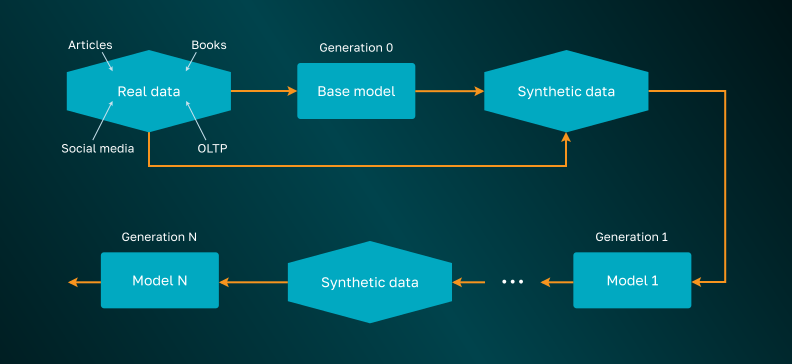
ML model collapse process
This effect occurs because the internet and other information sources used to train generative models contain more and more so-called synthetic data, that is, data generated by AI. Initially, generative AI, and LLMs in particular, learned mainly from data and content created by humans (books, articles, website content, social media comments, images, and videos) or by information systems that do not use AI. This article refers to such data as real data. However, as synthetic content becomes more widespread, more AI models use it for training, which pushes them closer to collapse.
Overall, the collapse mechanism is simple. A first-generation AI model learns from real data. However, any machine learning process produces errors, and those errors get into the synthetic content that the model generates. The next model learns from those outputs and introduces its own errors as well. After enough iterations, a new model ends up learning from nothing or almost nothing but errors, and completely loses its usefulness.
Model collapse has pushed researchers to look for ways to prevent it and reduce its impact. These approaches include tracking data lineage, keeping access to original sources, and "diluting" synthetic data with real data when you train AI models. Note that the EU General Data Protection Regulation (GDPR) directly requires organizations to document all actions with data, from its origin through decommissioning, to confirm lawful processing and compliance with data subject rights.
Sometimes, popular generative AI models even make the news because they produce inaccurate or meaningless outputs, also known as AI hallucinations. Although these hallucinations can look funny, the negative consequences of AI model collapse can be costly, and even tragic:
- Faulty decisions. Inaccurate outputs caused by AI model collapse can lead to expensive consequences for companies that use them to make management decisions. This can happen in any area, from customer support and marketing campaigns to stock trading and investment. For example:
- A collapsed model can recommend buying stocks that will fall, or investing in failed projects.
- An AI-based recommendation system can start offering the same items for many different customer requests. This can reduce customer loyalty, driving the company's customers to another seller.
- Loss of knowledge. Example: When you use an LLM to produce a scientific survey, it may include only the most cited and widely known knowledge, and ignore less common but still valuable information.
- Social tension. Collapsed AI models that make decisions in the social domain (e.g., allocating benefits, support measures, subsidized loans, or tax assessments) can start making discriminatory decisions against certain social or national groups, genders, or wealth status.
- Errors in engineering decisions. AI models are now widely used in engineering design and building complex high-tech products, infrastructures, and construction projects. AI collapse in this area can lead to incorrect technical and design decisions, causing accidents and disasters in manufacturing or transportation.
- Reduced data diversity. AI relies on its ability to process and interpret diverse datasets. Model collapse threatens exactly this ability by narrowing the diversity of the model's outputs. This resembles replacing a function that describes a complex system with only its mean value, and then trying to use that mean to predict the system's future behavior.
- Data contamination. As the amount of synthetic content on the internet grows, AI models train on it more and more intensively. This puts the quality and reliability of online information at risk.
- Limited access to real data. As model collapse problems become more acute, the importance of real data generated by humans or by information systems that do not use AI keeps increasing. This can create a situation where companies with access to real data gain competitive advantages.
Note that different types of generative AI models show collapse in different ways. For LLMs, the model starts producing meaningless outputs that carry little value, and may even contradict common sense. Text recognition models often start outputting the same characters for different handwritten letters and digits. Image generation models (for example, face generators) trained on their own previous generations start producing increasingly similar faces. Models used for data clustering build less and less distinguishable clusters as they collapse.
The figure below shows an example of model collapse when training on synthetic and partially synthetic data. Note how image quality drops with every generation:
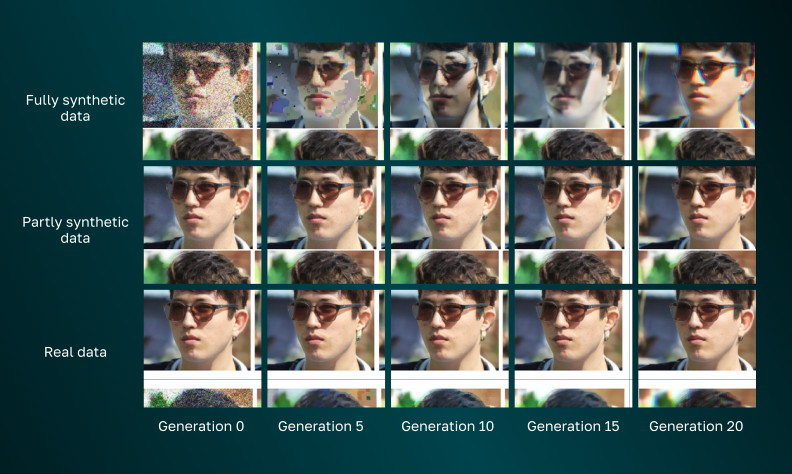
Example of AI model collapse
Preventing model collapse
As AI model collapse became a larger problem, researchers intensified work on methods to counter it:
- Preserving non-AI data sources. Prefer data sources that humans naturally created, or that information systems created without using AI (for example, OLTP systems. Training AI models on such data helps you avoid losing information about rare events, such as a customer preferring an unusual product, or researchers using information from a rarely cited study. The result may not be common, but it can still be relevant and accurate. When you preserve original data sources, you can periodically retrain a degraded model and restore its usefulness.
- Tracking data lineage. Use mechanisms that separate real and synthetic data to minimize the use of synthetic data when training AI models.
- Train on both real and synthetic data. Training an AI model on a mix of synthetic and real data reduces the probability of collapse and minimizes its level if occurred.
- Use higher-quality synthetic data. Apply data preprocessing to synthetic datasets to make them safer for future model training.
- Use AI governance tools. AI governance tools can reduce the probability of collapse by helping you monitor and control both training data and model outputs. If issues appear, this lets you adjust before they lead to significant losses.
- Monitor data statistics and react to significant deviations.
- Watch for repetitive, uniform, or clearly incorrect model outputs.
- Compare the outputs of different model generations to detect signs of collapse. When monitoring is part of the training process, you can detect early signs of potential collapse and activate mitigation mechanisms in time.
- Integrate user feedback at every training stage. Adding human-created data helps you align models with the real data distribution and reduce errors. You can use several types of feedback:
- Reinforcement learning from human feedback: Models receive rewards for outputs that are accurate, informative, and aligned with human perception.
- Error-correction loops: Experts review model outputs, correct errors, and add those corrections to the training datasets. This prevents error accumulation across model generations.
- Rare-event checks: People deliberately review rare or boundary cases that the model might miss. This helps you prevent early model collapse by preserving information about rare events in training data. When you use human feedback effectively, AI models become more resilient, stay aligned with the original distribution, and reduce the probability of performance degradation in later generations. This strategy ensures that collapse happens more slowly, or that you can prevent it altogether.
- Augment real data with synthetic data. Although synthetic data is considered the main driver of collapse, you can use it correctly to help prevent collapse by adding it to human-created real data instead of replacing it. For example:
- Mix real and synthetic data so that the model trains on a wider variety of situations instead of repeating the same ones.
- Fill gaps in original data with AI-generated examples, including rare or unusual cases that the model encountered infrequently. This works like giving the model a cheat sheet for difficult topics so future models do not forget them.
- Regularly compare model outputs with human-created data so you catch deviations early and confirm that the model still matches the original data distribution. This approach helps you build robust base models, prevent irreversible errors, and keep AI models reliable across multiple generations.
Mechanisms behind model collapse
AI model collapse typically occurs through the following mechanisms:
Loss of rare events ("tail loss")
The synthetic data the model generates after training always has a statistical distribution that differs slightly from the distribution of the training data. After several training iterations on synthetic data, the model can simply "forget" the original distribution. Events with a low probability of occurrence, which form the so-called tails of the probability distribution, disappear first. In other words, the model starts gravitating toward the most likely and most widely known data when it searches for an answer. Eventually, it produces what is most popular and in demand, not what is correct or important.
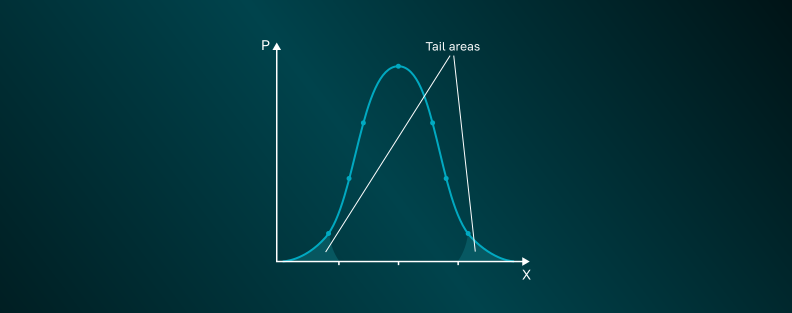
Tail loss during ML model collapse.
Researchers call model collapse associated with tail loss early collapse, because it happens in the early stages of the process. Late collapse occurs when the model output distribution no longer resembles the original distribution at all and usually has much lower variability. As a result, the outputs become nothing like the training data.
A collapsing model starts overestimating the importance of likely events and underestimating the importance of unlikely events. Over time, likely events start dominating the synthetic data, while less common but still important parts of the data, the tails, become less significant. These tails are necessary to keep model outputs accurate and diverse. With every new generation, errors seep into the data, and the model misinterprets them more and more.
Functional approximation error
This type of error occurs during model training and stems from limitations of the algorithms used. For example, an unfortunate choice of an objective function can prevent the model from approximating the function in the training data with sufficient accuracy.
In simple terms, every generative model tries to learn a mathematical function that transforms inputs (for example, a text description or an image template) into outputs that imitate human intellectual activity. At the start of the training, this function approximates reality well because it relies on high-quality data from multiple sources. However, as models start training on synthetic data, the approximation quality degrades.
At first, you can barely notice this degradation, and model outputs still look logical and accurate. Over time, however, the functional error accumulates. Instead of learning a complex continuous function that represents the original data distribution, the model learns an approximate distribution centered around its own outputs. In essence, the model starts optimizing simplified patterns that it generated earlier, rather than the richer and more complex data that the base model learned from.
Visually, the model is turning from a complex, detailed curve into a narrow peak, almost like a delta function that preserves only the most typical outputs:
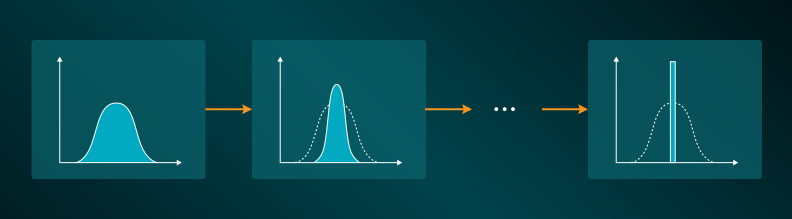
Loss of the original distribution
This happens when unlikely events and rare examples disappear from training datasets, which causes the model to lose information. As a result, the model collapses. Although it can still generate coherent text, it no longer reflects the real data distribution.
Functional approximation error is especially dangerous because it can hide behind seemingly stable performance metrics. The model can handle standard tests well, but fail on new or complex tasks. Without reintroducing real and synthetic data in balanced proportions, or without human correction efforts, the error accumulates across generations. This reduces performance and can lead to an irreversible model failure.
Functional expressivity error
This type of error occurs because the approximator has limited expressivity. In other words, the model lacks the capacity to represent all possible functions. In particular, neural networks, the core architecture behind deep learning, act as universal approximators only if their size approaches infinity.
Statistical approximation error
This is the main type of error arising from the finite number of samples used to train a model. It disappears only as the number of samples approaches infinity. In practice, this error occurs because each resampling step has a nonzero probability of losing information.
Amplification of model bias
This is one of the most underestimated and important causes of AI model collapse. When AI models repeatedly train on synthetic data, small deviations from the original data distribution start accumulating. With each new data generation, these deviations lead to large distortions in how the model interprets and reproduces information.
In early training stages, the base model typically learns from diverse human-generated data that reflects real-world variability, including language, context, tone, and so on. However, as training datasets gradually shift toward synthetic data, the data distribution narrows. The model starts training on an already biased representation of reality. When you repeat this process across later generations, the model exponentially amplifies these biases.
This effect is especially dangerous because it creates an illusion of consistency and improvement. Outputs may look logical and accurate, but in reality the model's understanding becomes more superficial and uniform. Without corrective measures, such as retraining on high-quality human-generated data, organizing user feedback loops, or restoring balance between real and synthetic data, the model will produce increasingly poor results. Bias amplification turns small inaccuracies into large errors, reduces how closely the model matches reality, and accelerates degradation.
In conclusion
The problem of AI model collapse raises serious concerns about the future of AI as more and more ot the world's natural content is being replaced by synthetic data. Some experts believe that AI development companies have exhausted the available real data for training their models, which forces them to switch to synthetic data. Indeed, generative AI systems produce content at enormous scale today. For this reason, model collapse is not just a theoretical concept, but rather, a global practical problem. The future of AI technologies and our interactions with them depends on how successfully we solve it.
Further reading:
See also

Megaladata as an Automation Tool: Case Study
How an E-commerce Retailer Reformed Replenishment in Three Months: Case Study
Replenishment planning for a large retailer means constant change: new seasons, new vendors, new regions. Every update used to mean a ticket and a wait. Here is what happened when they added Megaladata....

Semantic Layer
Large volumes of complex information force analysts to focus more on data management tasks than on data analysis. A specialized mechanism named "semantic layer" solves this problem. It provides a business...
About Megaladata
Megaladata is a low code platform for advanced analytics
A solution for a wide range of business problems that require processing large volumes of data, implementing complex logic, and applying machine learning methods.
GET STARTED!
It's free