
There's a version of this conversation that stays theoretical – data quality matters, governance is important, AI needs the right context. Everyone agrees.
DataOps: A Modern Data Management Technology

DataOps is an integrated, automated, process-oriented approach to collaborative data management. Adopting DataOps allows companies to turn data from a passive resource into a strategic asset and improve the speed, accuracy, and effectiveness of business decisions.
A new approach to managing the data lifecycle has taken hold worldwide. It brings together the development and operation of the software that supports this lifecycle. The core idea is simple: Create tight collaboration between development and operations teams through a culture of cooperation, well-defined processes, and enabling technologies that improve product reliability and quality. This approach spread across many IT domains and took names formed from the domain name plus the "Ops" suffix (meaning "operations").
Software development adopted this operational mindset first. The methodology became known as DevOps (development and operations). It focused on automating software build, configuration, and deployment. The results were strong enough that the concept soon expanded into other areas. For example:
- DecisionOps: Improves decision models by using data analysis and machine learning.
- AIOps: Improves the efficiency of a company’s IT infrastructure by using artificial intelligence technologies.
- MLOps: Enables efficient management of machine learning models, preventing ML collapse.
- NoOps: Maximizes automation of a company’s IT processes, eliminating (or minimizing) the need for staff to perform operations manually.
- FinOps: Automatically tracks and optimizes the costs of supporting a company's cloud infrastructure. The term is a blend of "finance" and "DevOps".
- SecOps: Provides a comprehensive approach to information security.
The family of "Ops" approaches keeps growing. They have become part of the lifecycle of most IT products. At the same time, ops skills have become an important way to assess a development team's maturity.
This article looks at DataOps: an integrated, automated, process-oriented approach to collaborative data management used by IT teams and analysts. A process-oriented approach means you treat data management as a set of connected processes that deliver a specific outcome, not as a collection of unrelated tasks. Today, you can also view DataOps as an independent approach to data analysis. It helps you get more value from data and treat it as a real asset, not dead weight.
DevOps optimizes software development work. DataOps focuses on automating data management and data analysis. It also prioritizes automation of repetitive manual work so data specialists can focus on strategic tasks. In simple terms, DataOps is DevOps for data. DevOps organizes continuous development and delivery of software. DataOps organizes continuous, frictionless access to data and a repeatable way to extract insights for management decisions.
DataOps goals and objectives
Many businesses see data as a company's most important resource. That only becomes true when you actually use it. If data sits unused, it stops being an asset and becomes a cost. To create business value and build a competitive advantage, corporate data must actively support better decisions about how you run the organization.
In practice, no IT organization can fully control and design every data management process an enterprise needs. Data now underpins complex business logic across many applications. As a result, the primary goal of DataOps is to deliver existing and new services and products quickly, even as requirements, the business environment, infrastructure, and data semantics change, while also protecting data security.
Key goals of DataOps include:
- Ensuring high business value of data and managing the associated risks.
- Moving away from manual data management (which consumes an unacceptably large amount of time as business needs change) and transitioning to automated data pipelines.
- Eliminating fragmentation between information producers and consumers.
- Improving the effectiveness of collaboration between teams responsible for data management and analysis.
- Organizing and orchestrating pipelines.
- Monitoring and ensuring data quality.
Traditional data management often relies on disconnected teams and lengthy analytics development cycles. DataOps helps you build a continuous analytics pipeline and shorten the feedback loop.
In other words, DataOps turns data analytics into a pipeline process. Like an assembly line in manufacturing (for example, automotive production), a pipeline helps you increase throughput, reduce costs, and improve quality through continuous control. In DataOps, the pipeline outputs analytical solutions instead of physical products.
| Traditional approach | DataOps approach |
|---|---|
| High share of manual work | Automated data pipelines |
| Separate teams of analysts and data engineers | End-to-end collaboration |
| Long development cycles (months) | Shorter cycles (days, weeks) |
| Reactive control of data and model quality | Proactive monitoring and rapid response to issues |
| Manual deployment of new versions of data management tools with downtime | Continuous delivery and deployment of new versions of data management tools and integration into analytics pipelines |
Core principles of DataOps include:
- Collaboration and interaction. DataOps helps to overcome fragmentation between data management teams, analysts, and business units through open communication and coordinated teamwork. It aligns goals, removes bottlenecks, and establishes a unified approach to data management.
- Automation. DataOps reduces manual work in routine tasks, data flow management, and monitoring.
- Continuous integration and deployment, often abbreviated as CI/CD (Continuous Integration/Continuous Delivery).
- Monitoring. DataOps suggests tracking key indicators throughout the data lifecycle to maintain performance, detect anomalies, and assess effectiveness in real time.
DataOps lifecycle: from raw data to business insights
The DataOps lifecycle starts with raw data and ends with insights that deliver high business value. It includes the following stages:
- Planning: Define a strategy for meeting business needs through data analytics: what steps to take and what technologies to use. Typically, teams also define the project budget and performance requirements at this stage.
- Development: Build your data processing pipelines through programming or using low-code tools.
- Integration: Assemble individual models into a single functional system.
- Testing: Verify that data meets the specified business logic and the desired result, and perform exploratory analysis.
- Release: Transfer data to a test environment for further validation.
- Deployment: Deploy data to a production environment.
- Operation: Provide the product (data and its analysis models) to stakeholders and request feedback. Use the feedback to identify issues and gaps and fix them quickly.
- Monitoring: Continuously observe the entire process to detect and correct deviations.
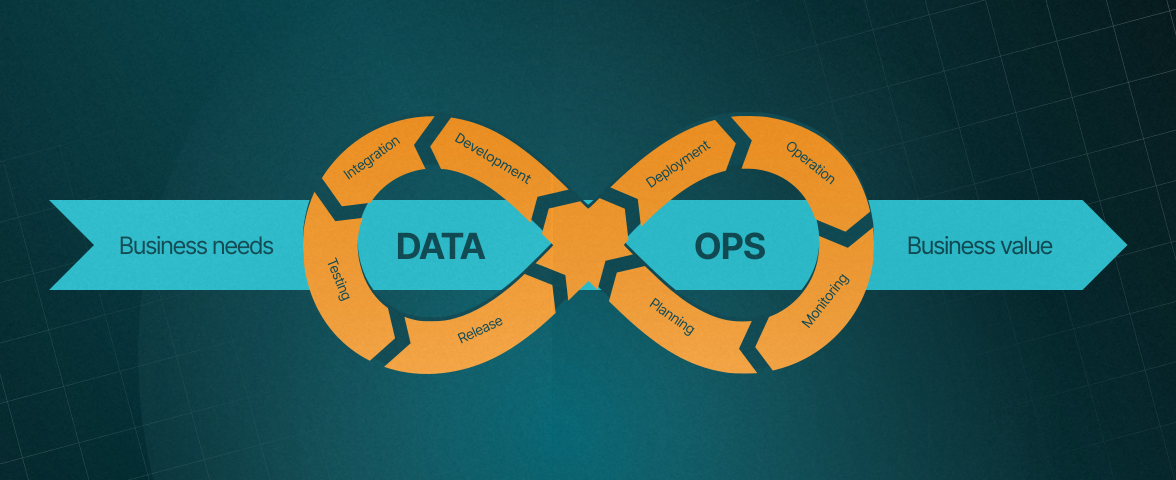
DataOps lifecycle
Core business needs when working in line with this data process include:
- high data quality
- effective teamwork
- reliability
- speed
- security
The desired business value includes:
- fast error detection
- understanding data (that is, 'insights') in real time
- efficient use of data
- growth of company capabilities
Processes implemented as part of DataOps
Using DataOps technologies implies implementing a set of workflows, including:
- Automating routine work related to extracting, transforming, and loading data (ETL/ELT), as well as controlling data quality and cleaning data.
- Continuous integration and delivery (CI/CD): Automated testing of model correctness, integrating models, deploying them to a production environment, and delivering them to all stakeholders.
- Continuous monitoring of data pipeline health, with metrics and logs that let you respond to failures in real time.
- Flexibility and scalability that preserve performance as data volumes grow and analysis tasks become more complex.
DataOps corporate culture
Finally, DataOps also requires the right culture and mindset. Without them, even the most advanced data management technologies will not deliver the desired results. To build a successful DataOps culture, it is crucial to align business goals with the organization's overall data management strategy. To do so, we recommend taking the following steps:
- Define clear and understandable business goals using the S.M.A.R.T. criteria (specific, measurable, achievable, relevant, and time-bound). A question to ask: What are the key objectives and strategic priorities the company aims to achieve?
- Identify stakeholders: Organize collaboration with various stakeholders such as executives, data engineers, analysts, and end business users. Make sure everyone understands the business goals and their own contribution.
- Define data requirements: Determine what types and formats of sources you will use, identify possible issues, and assess the availability and quality of existing information.
- Develop a data strategy: Create a management concept that includes all required procedures, as well as the software and hardware needed to collect, store, organize, analyze, and present data. The strategy must cover all aspects of data management, align with overall business goals, and ensure smooth integration with current systems.
- Adopt the DataOps principles and workflows described above.
- Monitor and adapt: Continuously track the effectiveness of data management processes and progress toward business goals based on defined key performance indicators (KPI) and metrics. Regularly review and adjust the strategy as business needs change, and address identified shortcomings and weak points in a timely manner.
- Develop a data culture in the company: Provide training opportunities and resources to support employees at all levels in building a data-driven mindset.
- Build cross-functional teams that include representatives from different units with different skills, knowledge, and experience. This interdisciplinary collaboration improves communication, supports shared understanding of complex issues, and increases overall effectiveness.
In conclusion
Adopting DataOps technologies is not a one-time project. It is a multi-stage effort that requires involvement and active work from employees across the company who work with data and care about outcomes. However, successful DataOps implementation helps you turn company data from dead weight into a valuable strategic asset, and do it as efficiently as possible.
Further reading:
See also

How to Build a Data Workflow That AI Can Actually Trust

How To Use Execution Order Ports When Running Megaladata Workflows
Megaladata automatically optimizes workflow execution: It runs only the nodes linked by a data chain and uses parallel computing. However, in some cases, you may need to set the execution order manually. You...

1 TB in Under 13 Minutes: Performance Test Report
For this test, we ran Megaladata 7.3.3, importing 1 TB from two production DBMSs simultaneously, with transformations applied, over a standard cloud network. Five consecutive runs. Average: 12 minutes...
About Megaladata
Megaladata is a low code platform for advanced analytics
A solution for a wide range of business problems that require processing large volumes of data, implementing complex logic, and applying machine learning methods.
GET STARTED!
It's free